
Learn about the driver medical eye test chart UK drivers must pass for HGV, PCV, or taxi licenses. Discover vision standards, what to expect, and how Precision Driver Medicals can help you pass your DVLA medical with ease.
Introduction
When it comes to obtaining or renewing your commercial driving license, your eyesight is one of the most critical factors that determine your fitness to drive safely. The driver medical eye test chart UK ensures that every driver meets the DVLA vision standards before hitting the road. At Precision Driver Medicals, we specialize in providing accurate, efficient, and DVLA-compliant driver medicals—including vision tests—to keep you driving legally and safely.
In this blog, we’ll break down what the driver medical eye test chart UK involves, who needs it, what standards apply, and how you can prepare for your test to make the process as smooth as possible.
Understanding the Driver Medical Eye Test Chart UK
The driver medical eye test chart UK, often called the Snellen chart, is the standard method used to assess your vision during a driver medical. This chart features rows of letters that decrease in size from top to bottom. You’ll be asked to read these letters from a set distance to measure your visual acuity, which helps determine if your eyesight meets DVLA standards for driving.
Purpose of the Eye Test
The eye test is not just a formality—it’s a legal requirement. The DVLA mandates specific eyesight standards for all drivers, particularly those applying for:
- HGV (Heavy Goods Vehicle) licenses
- PCV (Passenger Carrying Vehicle) licenses
- Taxi or Private Hire (PCO) licenses
- Drivers aged 70 and above renewing their license
These tests ensure that drivers have sufficient vision to detect hazards, read road signs, and operate vehicles safely.
DVLA Vision Requirements for Drivers
Before your driver medical eye test chart in the UK, it helps to know the DVLA’s minimum vision standards. These differ slightly depending on the type of license you hold.
Group 1 Drivers (Cars and Motorcycles)
You must be able to:
- Read a number plate from 20 meters (with glasses or contact lenses if needed)
- Have a visual acuity of at least 6/12 on the Snellen chart
- Have an adequate field of vision, with no significant blind spots
Group 2 Drivers (Lorries, Buses, HGVs, and PCVs)
For professional drivers, the requirements are stricter. You must:
- Have a visual acuity of at least 6/7.5 (best eye) and 6/60 (worst eye) on the Snellen chart
- Meet DVLA-approved visual field standards
- Not have any medical conditions affecting your eyesight that could impair safe driving
If you use corrective lenses, you’ll be required to wear them whenever you drive.
What Happens During the Driver Medical Eye Test
At Precision Driver Medicals, your driver medical includes a full eye test as part of the standard DVLA assessment. The process is simple and takes only a few minutes.
Step-by-Step Process:
- Verification: Our GMC-registered doctor will first confirm your identity and review your completed D4 medical form.
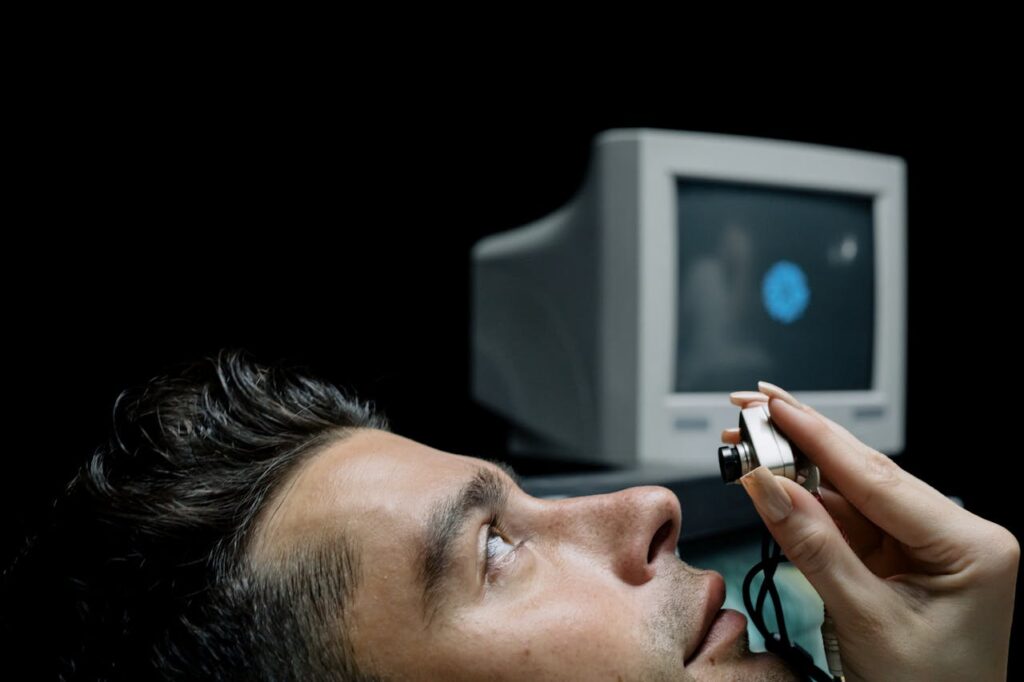
- Vision Assessment: You’ll be asked to read lines on the driver medical eye test chart UK at a fixed distance—usually 6 meters.
- Each Eye Tested Separately: The doctor will test one eye at a time, then both together.
- Use of Corrective Lenses: If you wear glasses or contact lenses, you can use them during the test. The results will be noted accordingly.
- Peripheral Vision and Medical Review: In some cases, a visual field test may be conducted, and your medical history will be checked for eye conditions like glaucoma, cataracts, or diabetic retinopathy.
The results are recorded on your D4 form and submitted to the DVLA as part of your medical report.
Why the Eye Test Matters for Drivers
Passing the driver medical eye test chart in the UK is essential because poor vision can significantly increase the risk of accidents. Many professional drivers spend long hours on the road, often under challenging conditions. Even a slight reduction in vision clarity or field of view can make a big difference in reaction time and road safety.
Key reasons why this test matters:
- Ensures road safety for you and others
- Helps identify underlying eye conditions early
- Fulfils DVLA legal requirements
- Prevents license suspensions or rejections
- Promotes confidence while driving professionally
Common Eye Conditions That May Affect Your DVLA Medical
Some eye conditions can impact your ability to pass the driver medical eye test chart in the UK. However, early detection and proper treatment can help maintain your license eligibility.
Common conditions include:
- Short-sightedness (Myopia)—Difficulty seeing distant objects clearly.
- Long-sightedness (Hyperopia)—Difficulty focusing on nearby objects.
- Astigmatism – Blurred vision due to irregular corneal shape.
- Cataracts – Clouding of the eye lens affecting clarity.
- Glaucoma – Increased pressure in the eye causing peripheral vision loss.
- Diabetic Retinopathy – Damage to retinal blood vessels due to diabetes.
If you have any of these conditions, regular eye examinations and appropriate corrective measures are crucial to maintaining compliance with DVLA standards.

How to Prepare for Your Driver Medical Eye Test
While you can’t drastically change your eyesight overnight, there are steps to help you perform your best during the driver medical eye test chart UK.
Preparation Tips:
- Bring your glasses or contact lenses. If you drive with correction, you must use it for the test.
- Rest your eyes before your appointment—avoid long hours on screens.
- Stay hydrated and get enough sleep.
- Bring your current prescription or optician’s report if available.
- Avoid alcohol or drugs that might affect your vision.
Following these tips ensures your results reflect your true eyesight and helps prevent unnecessary delays in your license process.
What Happens If You Fail the Eye Test?
Failing the driver medical eye test chart in the UK doesn’t necessarily mean you lose your license immediately. In most cases, it simply means further evaluation is needed.
- You may be referred to an optometrist or ophthalmologist for a detailed vision assessment.
- If you need new corrective lenses, you can get them prescribed and retested.
- Once your eyesight meets DVLA standards, your medical form can be updated, and your application resumed.
At Precision Driver Medicals, our doctors can advise you on the best next steps to get you back on track quickly.
Why Choose Precision Driver Medicals for Your DVLA Eye Test
At Precision Driver Medicals, we understand how important your license is to your livelihood. That’s why we provide fast, affordable, and DVLA-compliant driver medicals across the UK.
Our Key Benefits Include:
- Nationwide Clinics: Convenient locations in major cities including Birmingham, Manchester, Cardiff, and more.
- Qualified GMC Doctors: All medicals are conducted by experienced and fully registered practitioners.
- Same-Day Appointments: Book instantly online—no long waiting lists.
- DVLA-Compliant Forms: We handle your D4 medical form correctly the first time.
- Competitive Pricing: Affordable rates without compromising on quality.
- Friendly Service: We know how stressful license renewals can be—our team makes it simple and supportive.
When you choose us, you’re choosing a trusted partner in driver health and safety.
Final Thoughts
The driver medical eye test chart UK is a simple yet vital step in ensuring every professional driver can operate their vehicle safely and responsibly. Whether you’re applying for your first HGV license, renewing your PCO license, or undergoing a DVLA medical, meeting the required eyesight standards is essential.
At Precision Driver Medicals, we make the process quick, straightforward, and stress-free. Our GMC-registered doctors use accurate driver medical eye test charts and follow DVLA standards to help you stay compliant and keep your career moving forward.
Book your appointment today with Precision Driver Medicals—your trusted partner for driver medicals across the UK.
Top Services
- Driver Medical
- HGV/Lorry Drivers (HGV medical)
- Taxi Drivers (Hackney Carriage & Private Hire Medical)
- Private Hire
- PCV/Bus Drivers (PCV medical)
- PCO Medical
- Bus Medical Service
- Motorhome Medical
- Ambulance Medical
- Forklift Driver Medical
- TFL Medical
Top Links
- Book Liverpool City Council Private Hire Medicals
- Book Your Liverpool HGV Medical with Ease and Confidence
- Liverpool D4 Medical at Precision Driver Medicals
- HGV License Medical in Liverpool | Affordable Driver Medicals
- Taxi Medical Exam Liverpool
- HGV License Renewal Liverpool
- Our Google Reviews
- Area Coverage
- Home
- Booking Appointment
- FAQs
- Get Help
10 Important Links for Driver Medicals UK
- DVLA – D4 Medical Examination Report
→ Official D4 form for HGV/PCV drivers. - DVLA – Driving Licences for Lorry, Bus and Coach Drivers
→ Requirements for becoming a lorry or bus driver. - TfL – Private Hire and Taxi Driver Medical Requirements
→ TfL’s official medical guidelines for PCO/private hire drivers. - DVLA – Eyesight Rules for Drivers
→ Legal eyesight standards for all UK drivers. - DVLA – Medical Conditions and Driving
→ Guidance on how medical conditions affect driving eligibility. - NHS – Medical Exams for Professional Drivers
→ NHS overview of driver medical exams. - Driver & Vehicle Standards Agency (DVSA)
→ Regulator for driving and vehicle safety standards in the UK. - General Medical Council (GMC)
→ Authority for registered medical professionals in the UK. - Gov.uk – Renew Driving Licence
→ Process for renewing a UK driving licence. - National Register of LGV Instructors (NRI)
→ Training and standards for LGV/HGV instructors.
